Case study — zero-to-one product & business strategy
TripLingo
Turning a weekend idea into a paid mobile product, a venture-backed company, and a crash course in what it really takes to build from zero.
- The problem
- Short-term international travelers did not need fluency; they needed the right phrases, context, and cultural guidance for the trip they were actually taking — often where mobile data was expensive or unavailable.
- What I did
- Co-founder — helped shape the product and business strategy while personally designing and coding the user-facing product, testing prototypes, building the web, illustration, video, and motion work, supporting fundraising, speaking publicly, and later developing designers and interns.
- What shipped
- A coded Startup Weekend prototype became a shipped iPhone/Android product (later Nook), roughly 50,000 paid downloads/users in the first several months, about $2.35M in total venture funding, and a 2019 acquisition after I had stepped back from day-to-day operations.
Listen & read this case study
Opening
- 1×
- 1.25×
- 1.5×
- 2×
- 2.5×
- 3×
Loading audio
TripLingo is the clearest early-career proof of how I naturally work when there is no established organization to lean on.
I was not waiting for separate functions to appear. If the product needed design, frontend code, research, a landing page, an illustration, a pitch story, a motion piece, a conference demo, or a product decision, I got into it.
That did not mean doing everything forever. As funding arrived, I added people and shifted parts of the execution into a small team. But the founder years taught me something I have carried through the rest of my career: understand enough to lead it, know enough to challenge it, and when necessary, be able to make it.
The idea was simple. The execution had to make it believable.
TripLingo began at Startup Weekend Atlanta in January 2011. Jesse Maddox brought the core opportunity: travelers often spend a week or two abroad and do not need to learn an entire language. They need the language that helps them navigate this trip, this situation, this moment.
Over the weekend, I took the lead on the UI and worked with Jesse to turn the concept into an experience we could actually put in front of judges. We mocked up more than a dozen screens in two days — several for features we still had not built months later. We were not building a production application. We were building a coded prototype: real front-end code and a scripted interaction path, but no production database, account system, or backend capable of handling real users.
The difference was presentation. Jesse and I went on stage with a tightly scripted story in Keynote, then switched into the coded experience. Instead of asking the room to imagine the product from rough output, we showed a believable slice of what it could become.


Then we had to turn the performance into a real product.
The Startup Weekend version proved that people could understand the idea. It did not prove that TripLingo could survive contact with real users, real devices, real content, or real travel conditions.
The next product states were distinct: first, a materially more functional build for Startup Riot; then a pre-launch beta distributed through TestFlight; then the public mobile product.
The iteration pace was not subtle. In the first two weeks we looked at almost fifty versions of the dashboard, the flashcards, and the learning mode — design, discuss, tweak, redesign, show people, tweak again, all in a matter of hours.
I used paper prototypes and click-through prototypes to pressure-test interaction patterns before committing them to the shipped experience. I was deliberately pushing the interface away from stock mobile patterns, so I wanted evidence that the novelty still made sense to people: swipe behavior, previous/next controls, touch targets, the Slang Slider, and the trip quiz itself.


I designed and coded the user-facing product that shipped.
TripLingo was built with Appcelerator Titanium, which let us build cross-platform native mobile applications using JavaScript-based APIs. That fit the founding team well.
I owned the complete user-facing frontend experience: the product design, interaction behavior, and frontend implementation. Pratik owned the deeper backend and architecture — data wiring, storage, caching, media handling, memory/performance, and the technical systems required to keep a content-heavy offline product reliable.
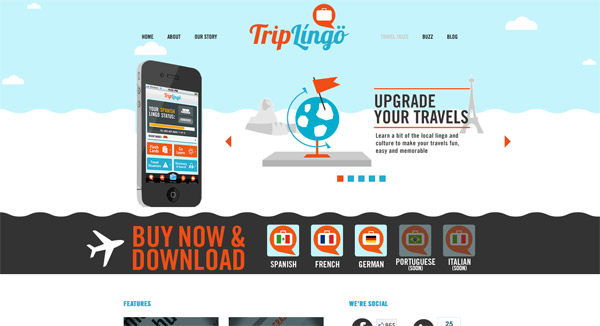
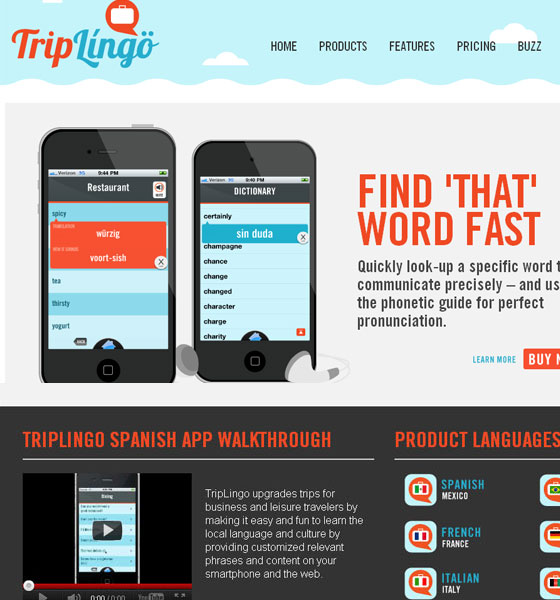
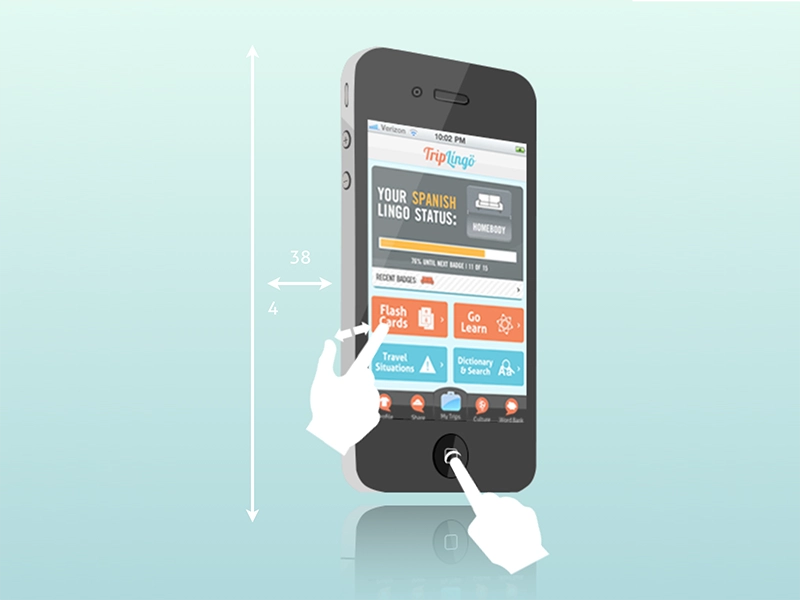
I also opted out of Titanium's stock components almost entirely. The speech-bubble motif ran through the whole app — instead of loading separate views or default modals, I animated little bubbles; progress bars, switches, modal windows, even the “open in Safari” popup were custom. Two text fields and one cancel button in the dictionary view were the only stock elements in the first release.
The customer need made those technical constraints real. International roaming in 2011 could be expensive enough that TripLingo had to remain useful without a data connection. A personalized set of phrases could expand into multiple contextual variants through the Slang Slider, plus audio, culture information, and learning tools. That made local storage, caching, and media optimization part of the product strategy — not implementation trivia.
Product design, interaction model, Titanium/JavaScript frontend implementation, prototype testing, web/landing experiences, visual system, and user-facing behavior.
Backend systems, data/model wiring, storage, caching, media handling, memory/performance, and the technical foundation behind the offline experience.


Don’t teach me a language. Help me handle the trip.
The first roadmap was not complicated because the job was clear: I am traveling internationally soon. What do I actually need?
The core experience asked enough about the trip to personalize a manageable phrase set, while still keeping a broader dictionary and phrase library accessible. The Slang Slider let travelers move a phrase across four registers — formal, casual, slang, and crazy — instead of speaking textbook-formal language everywhere.
Once that core was stable, we expanded around the traveler’s mental model rather than around a feature checklist: more languages and platforms first, then learning tools, cultural etiquette, business norms, safety information, live translation, custom phrases, and eventually image/text translation for menus and signs.
That also meant responding to the market without losing the center of the product. As connectivity improved and Google Translate changed expectations, translation became table stakes. We added it as a supporting capability while keeping TripLingo focused on the broader travel-companion experience.
Understand the trip
A short quiz created engagement and helped determine what situations mattered.
Personalize the language
Pull forward the phrases most likely to help instead of forcing a traveler through a phrasebook.
Match the context
Use the Slang Slider and cultural guidance to help language fit the social situation.
Work offline
Keep phrases, audio, and travel content useful even when international data was unavailable or expensive.
Learn enough
Flashcards and repetition supported the short-term traveler without pretending the product was a fluency program.
Be the companion
Culture, etiquette, safety, translation, and visual lookup broadened the product around real travel moments.
Storytelling was part of the product — and part of distribution.
One of the strongest things TripLingo taught me was that a good product idea can still die if almost nobody understands why it matters.
Jesse was comfortable presenting, but his consulting background naturally leaned toward dense informational slides. I worked with him on story arc, visual pacing, emotional connection, product demonstration, and the material that made the pitch feel like a product rather than a concept memo.
That same instinct extended into go-to-market. I created videos, motion graphics, illustrations, landing pages, social campaigns, and event material. Pratik and I also used our own technology speaking circuit as distribution: each conference appearance built our individual credibility and put the TripLingo name in front of another technology community.
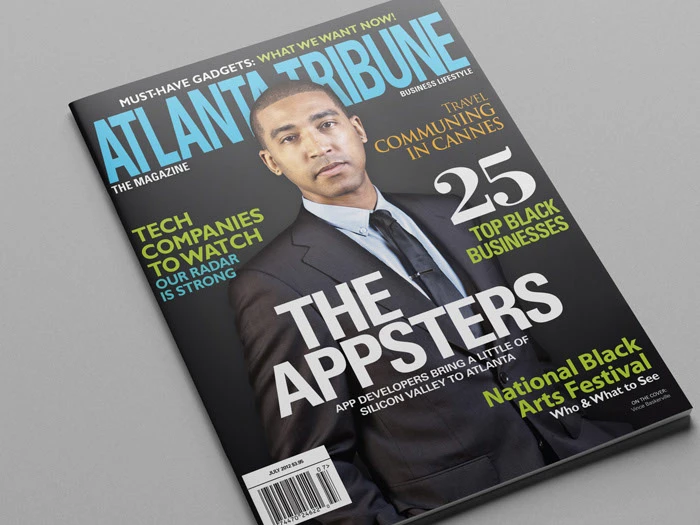
That visibility began attaching to me personally, too. In July 2012, Atlanta Tribune put me on the cover for “The Appsters,” a broader feature about Atlanta’s emerging app and technology scene. It was not a TripLingo-only story; TripLingo was part of the momentum that put my name into that conversation.
We were trying to build a business, not just sell an app.
The founders were skeptical of a consumer-only business from the beginning. Consumer distribution mattered because it gave us paid adoption, proof, visibility, and brand. But we did not believe individual App Store purchases alone would create the company we wanted to build.
The larger thesis was enterprise distribution: global companies, consulting organizations, education, corporate travel programs, and white-label partnerships that could put TripLingo in front of groups of travelers at scale.
That made prioritization a founder-level capital-allocation conversation. We made major calls together using a risk-versus-value lens: what creates near-term revenue or proof, what helps fundraising, what strengthens the scalable product, and what creates expensive distraction?
The most painful example was an early roughly $10K white-label engagement. It matched the long-term business model but arrived before we had a real white-label platform. We accepted it for the revenue, logo, and proof point, then paid for it in bespoke work, architectural distraction, enterprise change requests, and founder frustration.
Fundraising changed from “sell the vision” to “show the evidence.”
Early fundraising was primarily Jesse’s job because Pratik and I needed to build. I helped with the deck, visual story, and working builds so investor conversations reflected what the product could actually do.
Once the product stabilized and the company had raised a little over $1M, the model became more distributed. Jesse continued leading the business/investor side while Pratik and I increasingly represented TripLingo at technology conferences, investor conversations, and public events. We were not only pitching a travel problem; we were often using TripLingo while traveling internationally ourselves.
That experience taught me to think about Product strategy as an investment thesis: who controls capital, what evidence they need, what the next stage should prove, and how much investment is actually required to reach it.
TripLingo taught me to treat product strategy as an investment thesis.
Founder lesson carried forward: good ideas do not naturally find budget. You have to make value, risk, evidence, and the next bet clear to the people who control capital.
What changed
TripLingo moved quickly from a weekend project into a real operating company. The product launched on iPhone and Android, expanded into additional languages and platforms including Nook, earned repeated App Store and industry recognition, generated paid adoption, and opened enterprise/distribution conversations.
The company remained small enough that founders stayed close to execution. I eventually added designers, a Product contributor, interns, and other support, shifting pieces of the hands-on work into a team while continuing to shape Product and experience direction.
By mid-2013, the design system also began moving away from the highly customized, image-heavy interface I had originally built toward a more conventional UI that a broader engineering team could maintain. That was the right tradeoff for a maturing product: the early visual distinctiveness helped us stand out; later, maintainability and team scalability mattered more.
Delivery status
- iPhone app — launched on the App Store in spring 2011 with Spanish, French, and German; the custom interface and interaction system I built.shipped
- Android, then Nook — the same Titanium codebase carried across platforms.shipped / expanded
- Travel-companion expansion — flashcards, cultural guidance, safety content, translation, custom phrases, image/text translation.shipped / expanded
- White-label engagement — delivered as a bespoke implementation before the platform could repeat it.delivered / not repeatable
- Desktop / web product — a roughly month-long proof of concept, deliberately capped so mobile stayed the center.explored / capped
- Enterprise distribution — the thesis the company was still building toward when I stepped back in 2013.in motion

Why I stepped down
The hardest constraint was capital. I believed the next round needed to be at least around $2M for the company to scale the way the opportunity required. The round closed closer to roughly $1.1M. With a child on the way and the business still undercapitalized relative to the ambition, I stepped away from the full-time operating role rather than pretend the constraint did not matter.
What I'd do differently
Raise enough — or narrow the ambition
We were undercapitalized for the breadth and speed of the company we were trying to build. That constraint compounded across hiring, product stabilization, platform work, go-to-market, and fundraising. Several ideas were strategically correct and temporally wrong — white labeling, desktop expansion, platform architecture all had value, and doing them before the core product and team were ready created disproportionate cost. If I ran it again, the ambition and the round would be sized to each other before the first of those bets, not after.
What this work proves
TripLingo is the clearest evidence that my builder instinct is not a metaphor.
I can start from zero: I helped turn an idea brought into a weekend event into a product thesis, a coded prototype, a real application, a company, and an investable story. I can personally execute across disciplines — I designed and coded the frontend, tested the experience, built the web work, created the illustration, video, and motion assets, and helped shape the product story and GTM. And I can translate that craft into Product judgment: hands-on knowledge made prioritization, technical tradeoffs, offline architecture, platform decisions, and sequencing tangible rather than abstract.
I can think like an owner. Business model, customer proof, fundraising, cap table, hiring, runway, and opportunity cost were part of the same operating system as the roadmap. I can become a multiplier without losing maker fluency — as the company grew, I brought in designers and interns and shifted execution outward while continuing to shape Product and experience direction. And I know when evidence changes the decision: I stepped away from day-to-day operations when the capital available no longer matched what I believed the opportunity required to scale responsibly.
The through-line is the same one I have carried into larger organizations: make the opportunity understandable, make the product real, make the investment case credible, and know enough about the work to move between strategy and execution when the moment requires it.